 PERISCOPE
Periscope's AI Charter Working draft
An AI charter is a short, values-based document that defines an organization's relationship with AI and guides the decisions that follow. This is Periscope's, made with the same process I use with clients and published so you can see where I've drawn the lines.
Why write one
Most AI conversations inside organizations start with tools, efficiency, or risk. A charter steps away from all three and asks a different question: how do our values apply to the decisions AI keeps putting in front of us? Answering that once, on purpose, creates strategic clarity. Later choices about tools, training, data, and policy have something to stand on, instead of getting settled one vendor demo at a time.
Publishing it raises the stakes. A charter your board, partners, and the public can read is harder to quietly set aside, and that pressure is part of the design.
A charter comes before a policy
Values and principles
Why the organization uses AI, what it won't use it for, and the commitments it holds itself to. It guides judgment, fits on a few pages, and changes as the world does. It belongs early in AI adoption, because it shapes everything downstream.
Rules of the road
Who can use which tools, with what data, under what review. It comes later, once the organization knows what work it has chosen AI for, and it takes its direction from the charter.
How to use it
- Share it with your board and stakeholders so they know where the organization stands before they have to ask.
- Put it in onboarding so new team members learn how the organization works with AI from their first week.
- Consult it when a major AI decision comes up: a new tool, a new use of sensitive data, a partner who works differently than you do.
- Revisit it regularly, and whenever the technology, the organization, or the world around it changes markedly.
How a charter gets made
A charter is written with the people it will guide. The process draws on their experience and gives them a real say in the result.
- Listen. Interview staff or facilitate conversations about how people already use AI, what worries them, and what they want protected.
- Gather the record. Pull in what the organization has already written down: its mission, plans, website, and existing policies.
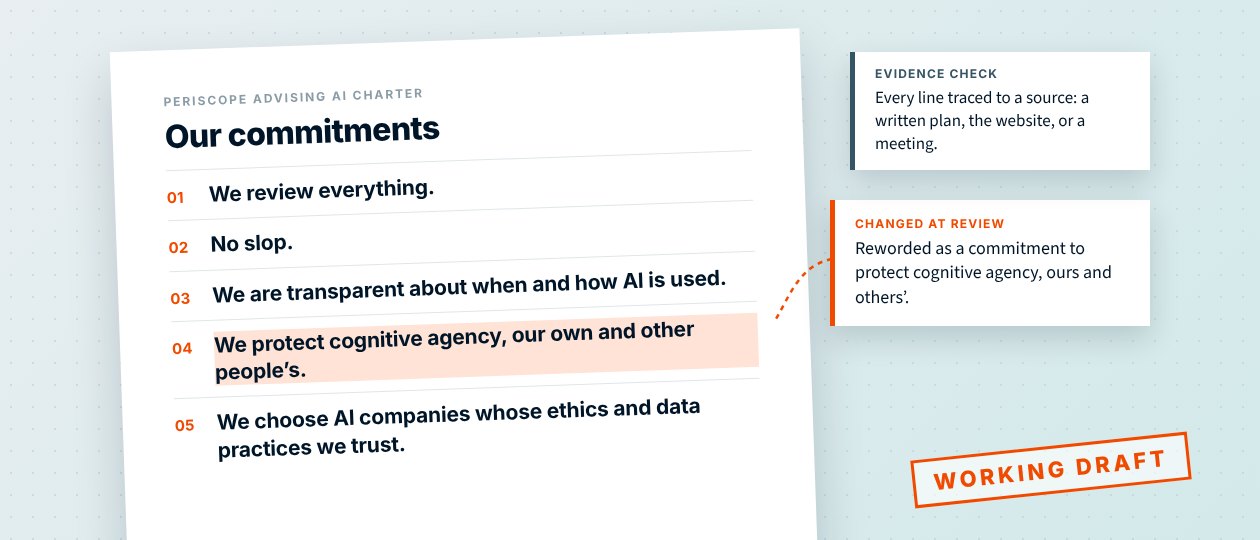
- Draft from the evidence. Every line traces back to something someone said or wrote. Anything thin or contested gets flagged for discussion instead of smoothed over.
- Revise together. People weigh in on the draft, and the changes are made in the open.
- Adopt it, share it, and keep it current. It moves into onboarding, board materials, and decision-making, and comes back for revision on a set rhythm.
How this one was made
For Periscope's charter, I was both the client and the reviewer. Claude, running my charter-drafting process, coded my website, written plans, published articles, proposals, and meeting transcripts into a record where every entry points to its source. I went through the draft in a question-by-question review and made fourteen corrections. A separate quality check then compared the charter against the record and blocked it over three sentences that went beyond the evidence or slipped into policy. Those came out before it was published.
It is labeled a working draft because it will keep changing. As more people work on Periscope engagements, their perspectives will shape the next revision.
Read the charter
Eight short sections: purpose, why, our relationship to AI, posture, commitments, how we use AI with people, what it means for the team, and how the document lives.